2020 kicks off with some new initiatives — UzhNU begins waste sorting

Initially, separate bins will be installed in the main building on BAM and in the rector’s office; there are plans to install bins in other buildings as well
The eco-friendly trend in Ukraine is gaining momentum. More and more people are realising that being eco-conscious isn’t difficult: sorting waste is simple; using a reusable bag instead of a plastic one is not only environmentally friendly but also practical and stylish; and drinks are just as tasty without a plastic straw. From the new semester in 2020, UzhNU is introducing waste sorting. The Media Centre found out how this will work.
The need to launch waste sorting had been felt for a long time; many people were aware of it, but never got round to actually implementing it. What’s more, UzhNU volunteers have taken part in several large-scale eco-campaigns in the city.
Hanna Meleganych during the clean-up of Student Embankment in September 2019.
Hanna Meleganych during the clean-up of Student Embankment in September 2019.
“Waste sorting is an urgent necessity not only for UzhNU, but also for the city, the region, the country and the world as a whole,” says Hanna Meleganych, head of the Resource Centre for Sustainable Development and associate professor at the Department of International Studies and Public Communications. “Throughout 2019, we tried to apply for various grants to raise funds for waste sorting at UzhNU, as it is quite resource-intensive.”
One might ask: why would implementing waste sorting be expensive, and what is the problem? Because, in the context of the university, it is a large-scale operation. The Rector’s Assistant, Kristina Tovt, explains: “The cost of a single cardboard bin is 100 hryvnias; a set of three, accordingly, is 300. To implement the initial project, we need over 20 such sets to install them in several locations on every floor. Of course, we won’t be able to make a profit from this, as the value of recyclable materials, especially paper, has fallen. But the main thing for us is to teach young people to sort waste and reduce the volume of plastic waste. We want young people who learn and get used to sorting at university to take this culture home with them — mainly to different parts of the region.
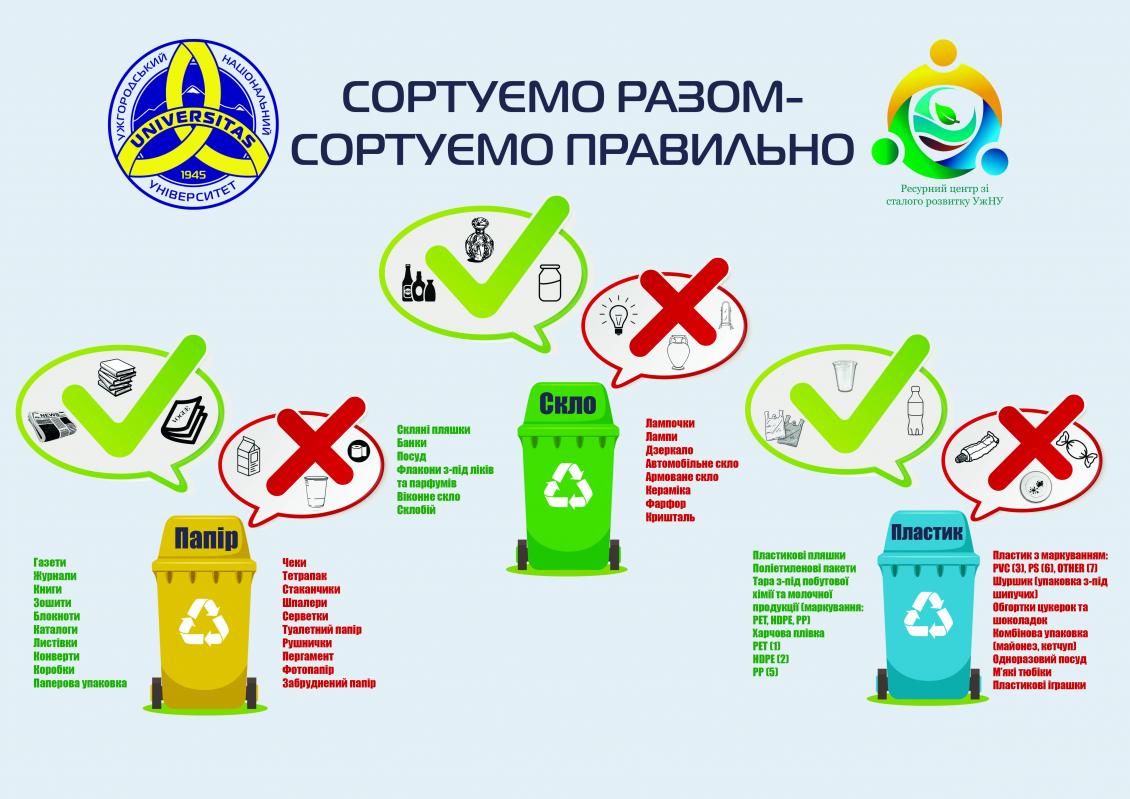
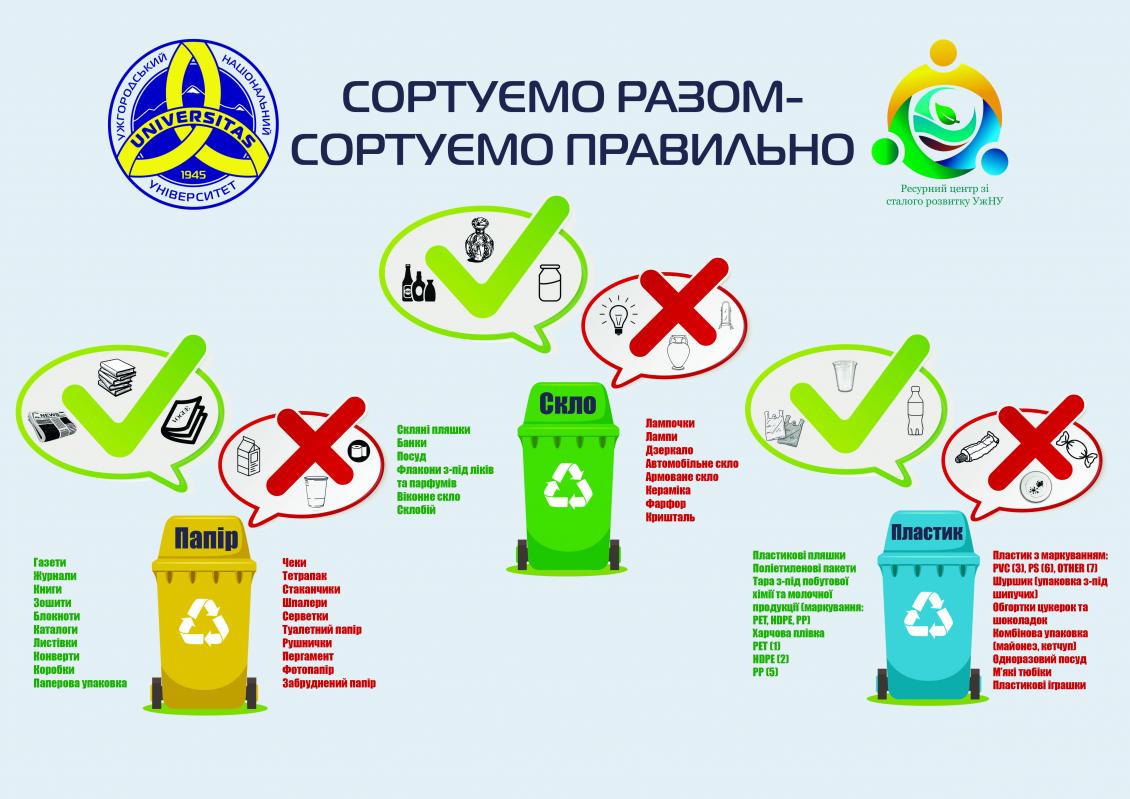
“We will try to reduce the number of standard bins and install separate containers for collecting recyclable materials: paper, plastic and glass — each container will have detailed instructions on what can be put in it. Of course, in university halls of residence we expect more paper, but students eat sweets, drink water and juices, and so on. As for the collection of paper cups, Mamai’s recycling bins will come in handy here; these were introduced last year by the ‘Aura Academica’ student space and have already become familiar to staff at the building on Narodna Street,” adds Hanna Meleganych.
During the clean-up of the Student Embankment in September 2019
During the clean-up of the Student Embankment in September 2019.
The project is not being implemented alone: the NGO “Green City”, whose activist is Ivan Zub, a student of the Faculty of Engineering and Technology, has been brought on board to collaborate with the Resource Centre for Sustainable Development and the UzhNU Rectorate. As part of the Uzhhorod City Council’s start-up competition, the young man wrote a project on an environmental theme, which was refined and began to be implemented at the university. Thus, it turned out that this initiative does not come ‘from above’ — it is proposed and supported by the students themselves.
Ivan Zub himself explains: “At the moment, most students don’t sort their rubbish — naturally, because this is something you need to learn and get used to from childhood. My friends support me; I can see that most of them understand the need for waste sorting, but not everyone is ready to just pick it up and start sorting. But we’ll set a precedent that will encourage students to do so. We’re already working with schoolchildren and can see they find it interesting. What’s more, they take this knowledge home and teach their parents. And the university is our larger-scale attempt to make our city cleaner.”
Waste sorting will begin in the new semester in the main building at BAM and the rector’s office. There are plans to expand the placement of sorting bins to other buildings in the future.
Over time, the plan is to replace paper bins with wooden ones, install plastic bins on the streets, and even create compost pits near the halls of residence. What’s more, the Rector’s Office is also considering an incentive scheme for those who sort their waste.
To help the sorting initiative take root more easily and make it simpler to get started, information sessions will be organised for university staff and students.
For now, students, lecturers and concerned members of the community are invited to help promote waste sorting. Students who are willing to support this initiative within their faculties are asked to contact the Sustainable Development Resource Centre by email: [email protected]
Kseniia Shokina