Biology students gained practical insight into the role of deadwood in the forest

The event took place as part of the Romanian-Ukrainian project ‘Promoting Deadwood for Sustainable Forests in the Romanian-Ukrainian Cross-Border Region (RESFOR)’
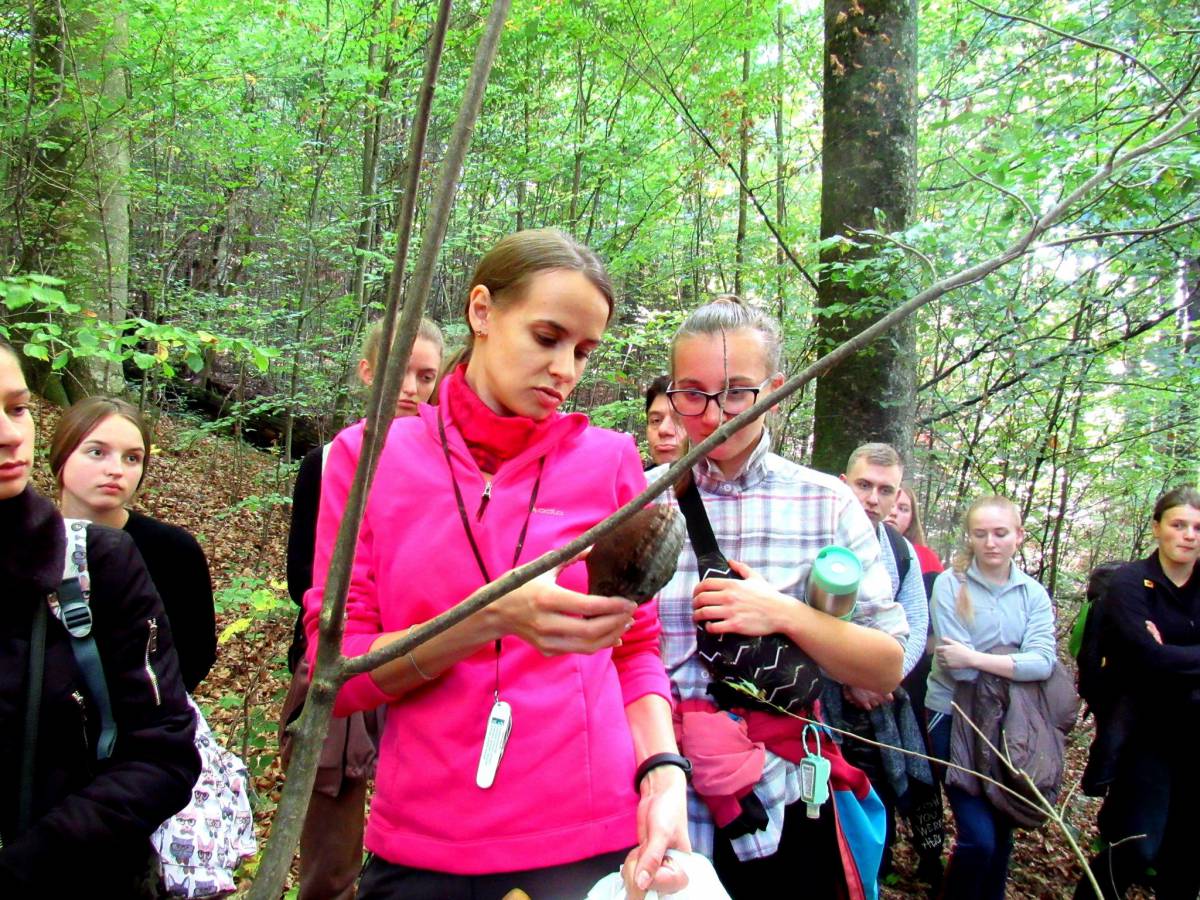
From 28 to 30 September, a training and practical seminar entitled ‘Deadwood. Why is it necessary for the forest?’ was held for first-, second- and fourth-year undergraduates and postgraduate students of the Faculty of Biology at UzhNU. The event took place as part of the Romanian-Ukrainian project “Promoting Deadwood for Sustainable Forests in the Romanian-Ukrainian Cross-Border Region (RESFOR)”, which is being implemented by WWF Romania in partnership with the University of Suceava, the NGO “Ecosphere” and the Ukrainian Research Institute of Forestry.

The seminar was organised by the NGO “Ecosphere” in collaboration with the Faculty of Biology at UzhNU and the Carpathian Biosphere Reserve. Researchers from the Faculty of Biology at UzhNU, the Carpathian Biosphere Reserve and the Ukrainian Research Institute of Forestry worked with the students.
During the seminar, students were provided with specialist scientific information on deadwood in forests, which serves as a distinct habitat for thousands of forest species: slime moulds, fungi, mosses and lichens, insects and vertebrates. The functional role of dead wood was also demonstrated, highlighting how it enhances the resilience of forests to external influences, particularly climate change. The students were able to see for themselves the rich biodiversity of the primeval forests, which is sustained precisely by dead wood throughout its full decomposition cycle; as a result, through food chains, it stores up to 10% of the carbon that the tree absorbed during its lifetime. During the field trips to the established plots in the primeval forests, the students were able to see several Red List species of fungi and a bat.
“I am very grateful to the seminar organisers,” says fourth-year student Mykhailo Husar. “I learnt a lot of useful things and had the opportunity to talk to professionals. I would like to see students continue to take part in such seminars. After all, we, as future biologists, need this to gain practical experience. Thank you very much for such a meaningful few days!”
“The seminar turned out to be extremely interesting and informative,” adds second-year Master’s student Khrystyna Hankulich. “I realised the true value of dead wood and its role, and thanks to the lecturers’ discussion, I also had the opportunity to weigh up all its pros and cons and draw my own conclusions about its significance for forests. Thank you very much for the opportunity to expand my knowledge.”